Chapter 11
Under stress, there are those who try harder, and there are those who lower their standards. Until very recently, the first response was considered a virtue, the second was considered a vice. The ongoing wave of burnout and people quitting or cutting back on work when they can afford to suggests this societal norm is shifting. I want to propose an inversion of the valences here, and argue that under many conditions, lowering your standards is in fact the virtuous thing to do.
A mediocritizing mindset typically doesn't bother with such ethical justification, however. It typically rejects the idealism inherent in treating this as a matter of virtue vs. vice altogether. Instead we mediocrats try to approach the matter from a place of sardonic self-awareness and skepticism of high standards as a motivational crutch. This tweet says it well enough:
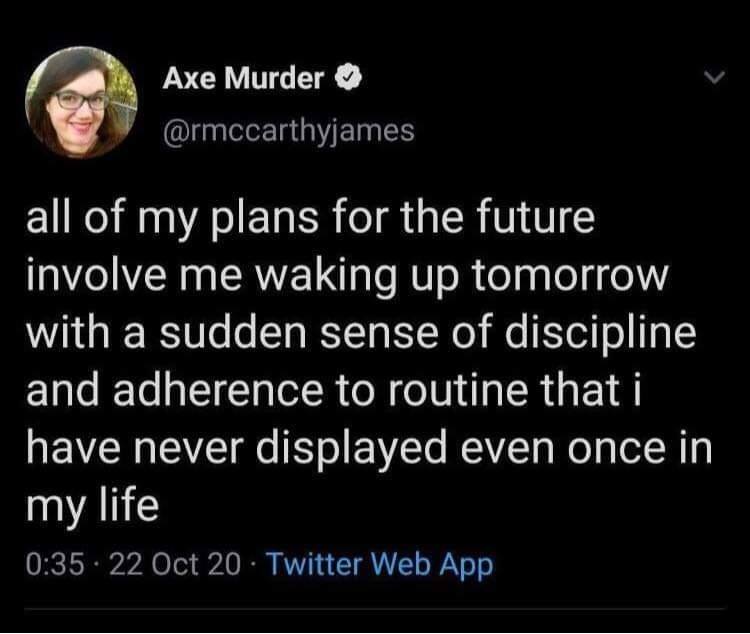
This is less cynical than it seems. Motivation, discipline, and energy are complex personality traits. While they are not immutable functions of nature or nurture, they do form fairly entrenched equilibria. Shifting these equilibria to superficially more socially desirable ones isn't merely a matter of consuming enough hustle-porn fortune cookies or suddenly becoming a true believer in a suitably ass-kicking philosophy like stoicism or startup doerism. Life is messier than that.
You can't exhort or philosophize your way into a new regime of personal biophysics where you magically try harder or behave with greater discipline than you ever have in your life. Gritty, driven people tend to have been that way all their lives. Easy-going slackers tend to have been that way all their lives too. People do change their hustle equilibria, but it is rare (and pretty dramatic when it happens). And the chances of backsliding into your natural energy mode are high. Driven people will find it tough to stay chilled out, and vice versa.
Emergencies and life crises can trigger both temporary and permanent changes. Type A strivers might let themselves relax for a few months after a heart attack, or make permanent changes. A slacker might find themselves in a particularly exciting project and turn into driven people for a while, and occasionally for the rest of their lives.
But the stickiness of these equilibria means the response to stressors is typically something other than behavior change, and that's a good thing. Typically it is lowering standards while retaining behaviors.
For me the Aha moment was sometime in 2008 when I heard David Allen of GTD fame make what I later realized was his trademark joke -- the easiest way to improve your productivity is to lower your standards. The remark had a major permissioning effect on me. Previously I was a standards-lowerer type but used to feel guilty about it. After hearing David endorse the life hack, I became an unapologetic standards lowerer.
The thing is, the addition of stressors changes the effort/reward equation of your entire life. Old behaviors are now costlier, and the reward is possibly smaller. If you have higher energy levels, you can compensate by "trying harder" for a while. It either means marginal energy expenditure is cheaper for you than for others, or that the reward was worth more to you all along and you were just getting a big discount relative to what you were willing to pay.
But everybody has a limit past which the prevailing effort/reward equation stops making sense, but it's not yet clear how to craft a new one. You have to buy time and energy to decide what to do. Lowering standards is one way to do that.
Lowering standards simultaneously lowers the cost and reward, while minimally disrupting the nominal pattern of your life. It is also a socially robust strategy. Human collectives have a vast array of evolved strategies for dealing with cooperation under conditions of unpredictably falling standards. We are constantly negotiating other people's shifting standards, both implicitly and explicitly with our own compensations.
Making and eating a sandwich when you're fresh and well-rested is a different task than when you're tired and hungry after a long day. Under the former conditions, you might put in the patient time and effort to make yourself a great sandwich. Under the latter conditions, you'll likely throw together whatever. That's lowering standards. You're still eating a sandwich, so that part of your lifestyle is stable. If you're making sandwiches for everyone in your family, well, they can deal with a mediocre sandwich. You've externalized your increased costs by lowering others' value.
A modified version of Chesterton's Fence is a good lens on this. An entrenched equilibrium in your life is like a fence in a field whose purpose you don't quite grok. You get part of why it's there, but not all of it. When faced with a stressor that seems to require choosing between tearing the fence down entirely (changing the equilibrium by force) and preserving it absolutely (refusing to change at all), you don't do either. You kinda just partly knock down the fence, so it's a lower quality fence. It will continue serving its functions, but perhaps not as well. It will create new freedoms to address new circumstances, but perhaps not quite as well as tearing down the whole fence. Like many things that result from a mediocritization life posture, it's a half-measure. A compromise.
And in fact, this is how real fences seem to age in the world. Usually non-critical fences mysteriously acquire gaps or breaks over time that are part of undocumented short cuts. You pave the cowpaths through the fences, but in a half-assed way.
Sometimes your mind and body work with you to lower standards. When you're really hungry, almost any food tastes great. You brain jacks up the subjective reward, and that compensates for lowered effort. Other times, that doesn't work, and you get a definite dowgrading of experienced reality.
You can't be naive about all this of course. If you're a pilot or surgeon, lowering standards below a very high minimum is life-threatening for other people. If your Chesterton Fence is a fence around a prison yard keeping dangerous criminals locked up, you probably don't want to cut gaps into it.
Even if you're willing to risk your own life by lowering standards, risking others' lives is a different matter (though a consensus lowering of standards in a group, with a chance to opt out, is the same strategy at a group level).
But even in apparently unforgiving situations, there are options. As a surgeon or pilot, you could simply work fewer hours for less pay.
If your services are direly needed, that creates a different kind of tension, but for the kinds of people who get into such service careers, typically being needed more raises the reward, and more effort becomes worth it.
There is a subtler effect which you can't control. The task may be such that there is no meaningful way to lower standards at all. You either do it at a high level or you don't do it at all. Creative work is typically of this sort. If you're an award-winning poet, there's no point lowering your standards to craft crappy verses.
I like to think of this in terms of the marginal cost of energy -- certain activities really only work when fueled by the relatively cheap energy that you can just waste, just as certain investments are only worth it when the cost of capital is low enough.
Enslaving a poet and whipping them will not produce good verses any faster. This is why all creative professions tend to feature phenomena analogous to "writers' block." Athletes go through lean patches in their sports. Actors produce uninspired or strained performances. You can't hustle your way out of this stuff, nor can you "lower your standards." The only solution is to not do it at all for a while, and try to recover your mojo some other way.
There's a lot more phenomenology here I'll leave you to meditate on, but let's get to the claim I made originally, that it's possible to invert valences and see lowering standards as a virtue, and sticking to them at all costs as a vice.
In the modern world, the default moral perspective is heavily in favor of maintaining standards. Quality control is a proxy for morality. You have idioms like cutting corners, shortchanging, and sandbagging that associate lowered standards with dishonesty. You have aphorisms like "good is the enemy of great." You have a fetishization of workmanship in form regardless of function.
And certainly there are dangers there it's worth being aware of.
A big one is that lowering standards can turn into an unbounded spiral of continually falling standards, as you get used to lower and lower levels of energy expenditure with few visible costs. This is one way a pattern of increasing, self-reinforcing neglect can work (though a far more common way is for things to be neglected due to moral hazards, in service of greater extracted profits).
Another big one is the danger of simply being in a rut. Sometimes you have to shake things up just to get out of ruts, and lowering standards tends to make it easier to stay in a rut, since you can now sustain being in it at lower energy and payoff levels.
But clearly a mediocre sandwich is preferable to starvation. Random coffee is good enough to get going in the morning if you can't get your perfectly brewed pour-over. If you're super sensitive to the taste of water, and only like a particular brand of bottled water, you can still drink tap water.
Setting aside things that are purely matters of taste, even when there are functional and life-critical aspects, lowering standards is sometimes the right answer. Emergency response medical treatment is pretty much all about delivering good-enough care now, when waiting for the perfect care will kill you. Lower standards to what you can deliver now. A half-assed intervention now might is better than a perfect intervention after you're dead. An MVP today, with the window of opportunity open, is better than the perfect product next decade.
But it's not merely a matter of pragmatic triage and 80-20 Pareto principles and dynamically optimizing an indeterminate time-sensitive thing.
There is a philosophical and ethical reason to respond to stressors by lowering standards. Stressors are a sign of a changing environment that create a growing imperative to reconsider your behavioral choices.
Lowering standards is implicitly a way to value the illegible whole of your life, over its entire indefinite future, over any narrowly legible aspect, especially one that only matters in a fixed way within a fixed time horizon.
Lowering standards is how you back off from prematurely optimizing outcomes in a particular finite game in favor of extending and enriching the infinite game. Lowering standards is how you create room in your illegible life utility function to change standards altogether. And you do it all without prematurely disrupting the nominal forms of your life too much. It's often better to phone it in while you figure it out, rather than abandoning things outright. After all, you might decide the right thing to do is to raise the standards again with a renewed commitment.
Lowering standards can be understood as the kaizen of irreversible disruption. It is using a slippery slope as a feature rather than a bug. It is kinda half-burning your bridges. It is doing radical things in an incremental way.
I think a broad-based philosophy and ethos around this idea has been developing in the zeitgeist for nearly a decade.
Many of Nassim Taleb's ideas fit this way of thinking. Lowering standards is Lindy. Lowering standards progressively until you get to what can be indefinitely sustained is antifragile. Making idealistic plans that require you to display a "sudden sense of discipline and adherence to routine" you've never displayed before in your life is fragile. I think though, that he has some important commitments (or what I think of as hangups) that would conflict with a full-fledged endorsement of mediocrity as a life posture. But then, half-hearted endorsement would actually be more appropriate. After all, you have to be willing to lower your standards when it comes to adherence to the idea of lowering standards.
James Scott's ideas on legibility also fit this theory. Standards are a feature of legible models of behavior. If you're unwilling to let go standards, you're unwilling to let go authoritarian high-modernist legible models of your own behaviors.
Ironically, hitting higher standards in an engineering sense (I've been reading a lot lately about the history of standards and precision) is usually about changing what you're doing at a physics and metrology level rather than killing yourself trying to do hand-carpentry with nanometer precision. In engineering, sticking to exacting and uncritical standards makes you a John Henry, not an innovator. There's really not much point to being the best steel-driving man after then invention of the steam-powered rock drilling machine. If he'd only lowered his standards, and negotiated a different or lower role in a steam-powered world, he'd have lived on and perhaps enjoyed life in a different way.
On the flip side, it's easy to see how sticking to high, idealistic standards can turn into a vice. The standards may be irrelevant in a changed environment. You may be delivering to high standards by externalizing costs or operating under serious moral hazard. You may be delivering to higher standards through coercive bullying of others you have undeserved and illegitimate power over, when they have no way to opt out of the authoritarian commitments you've made on their behalf.
That last one, by the way, is the proximal trigger for a lot of lowered standards. When underpaid workers with no better options are coercively driven by authoritarian bosses, often their response is to lower standards in ways that ease their lives but the authoritarian can't easily police. The trope of the exploited worker surreptitiously jamming a wrench into the machinery to "negotiate" a break is a way of renegotiating conditions through lowered standards (of uptime and maintenance costs in this case).
A good definition of humane is actually conditions where standards can be legitimately lowered in a way that's appropriate for the uncertainties of the circumstances of the specific kind of work. Designing systems to be humane is to design them for real humans who don't suddenly "develop a sense of discipline and adherence to routine" they've never exhibited in history.
To bring it back around to the wave of quitting in response to pandemic burnout that inspired this post, that's a case of people intuitively, and correctly, realizing that lowering your standards of adherence to the societal script of careerism is the right thing to do when you sense an illegible toll on mental and spiritual health. Even if you don't know quite why you're unhappy with the current equilibrium, lowering your standards is a good idea. Lowering your standards around whatever you're up to is the best way to challenge your understanding of both the situation, and yourself.
If you're unhappy with your life in ways you can't quite figure out, lowering your standards relative to your commitments is one way to fuck around and find out what's wrong.