Chapter 10
I once read a good definition of aptitude. Aptitude is how long it takes you to learn something. The idea is that everybody can learn anything, but if it takes you 200 years, you essentially have no aptitude for it. Useful aptitudes are in the <10 years range. You have aptitude for a thing if the learning curve is short and steep for you. You don't have aptitude if the learning curve is gentle and long for you.
How do you measure your aptitude though? Things like standardized aptitude tests only cover narrow aspects of a few things. One way to measure it is in terms of the speed at which you can do a complete loop of production. Your aptitude is the rate at which this cycle speed increases. This can't increase linearly though, or you'd be superhuman in no time. There's a half life to it. Your first short story takes 10 days to write. The next one 5 days, the next one 2.5 days, the next one 1.25 days. Then 0.625 days, at which point you're probably hitting raw typing speed limits. In practice, improvement curves have more of a staircase quality to them. Rather than fix the obvious next bottleneck of typing speed (who cares if it took you 3 hours instead of 6 to write a story; the marginal value of more speed is low at that point), you might level up and decide to (say) write stories with better developed characters. Or illustrations. So you're back at 10 days, but on a new level. This is the mundanity of excellence effect I discussed in part 3, and this is an essential part of mediocratization. Ironically, people like Olympic athletes get where they get by mediocratizing rather than optimizing what they do. Excellence lies in avoiding the naive excellence trap.
This kind of improvement replaces quantitative improvement (optimization) with qualitative leveling up, or dimensionality increase. Each time you hit diminishing returns, you open up a new front. You're never on the slow endzone of a learning curve. You self-disrupt before you get stuck. So you get a learning curve that looks something like this (yes, it's basically the stack of intersecting S-curves effect, with the lower halves of the S curves omitted)
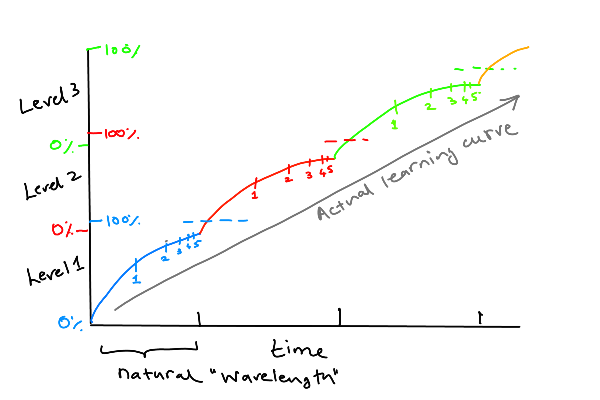
The interesting effect is that even though any individual smooth learning effort is an exponential with a half-life, since you keep skipping levels, you can have a roughly linear rate of progress, but on a changing problem. You're never getting superhuman on any vector because you keep changing tack to keep progressing. The y-axis is a stack of different measures of performance, normalized as percentages of an ideal maximal performance level, estimated as the limit of the Zeno's paradox race at each level.
Now we have a slightly better way to measure aptitude. Aptitude is the rate at which you level up, by changing the nature of the problem you're solving (and therefore how you measure "improvement"). The interesting thing is, this is not purely a function not of raw prowess or innate talent, but of imagination and taste. Can you sense diminishing returns and open up a new front so you can keep progressing? How early or late do you do that? The limiting factor here is the imaginative level shift that keeps you moving. Being stuck is being caught in the diminishing returns part of a locally optimal learning curve because you can't see the next curve to jump to.
Your natural wavelength is the rate at which you level up (so your natural frequency is the inverse of that). Two numbers characterize your aptitude: the half-life within a level, and the number of typical iterations you put in before you change levels (which is also -- how deep you get into the diminishing returns part of the curve before you level up).